- May 15, 2025
- Shruti Kulkarni
Overview
Welan Technologies, an industrial-solutions provider specialising in sound & vibration systems, transducers and test & measurement equipment, faced operational inefficiencies caused by multiple disconnected systems and manual workflows. By migrating from Zoho Bigin to the full Zoho One suite via partner ITOT Cloud Systems, Welan achieved improved departmental collaboration, data integrity, automation, real-time visibility and scalability. Key takeaways: elevated CRM adoption, faster collections, streamlined HR and payroll, unified inventory/sales/finance, and marketing automation.
Executive Summary
Welan Technologies is headquartered in Pune, India, and employs 25 staff across sales, finance, HR, operations and marketing. The company distributes advanced industrial test and measurement equipment nationwide. Originally they adopted Zoho Bigin to manage leads but soon realised that the lightweight CRM offered limited customisation, no AI/forecasting, no third-party integrations and minimal automation. Simultaneously, finance, HR, inventory and marketing systems remained fragmented—spreadsheets, email trails, WhatsApp chats and legacy standalone tools dominated.
Recognising these limitations and with growth plans underway, Welan partnered with ITOT Cloud Systems to deploy Zoho One covering CRM, Books, People, Payroll, Inventory, Expense, Cliq, WorkDrive, Campaigns and Social. The rollout delivered centralised data, streamlined processes, enhanced inter-departmental collaboration and real-time dashboards. As a result, Welan now operates on a scalable, integrated platform supporting efficiency, compliance and growth.
Problem Statement and Key Challenges
Welan’s pre-implementation environment presented multiple interconnected challenges:
-
- Heavy manual dependency: Sales, finance, HR, inventory and operations heavily relied on Excel sheets, Gmail folders and email chains. Data duplication, version confusion and calculation errors were frequent.
-
- Low user adoption: Although Zoho Bigin was in place, many employees resisted digital workflows and preferred manual tracking, causing CRM usage to be inconsistent and incomplete.
-
- Data fragmentation: Customer data, deal histories, quotations, stock levels, supplier records and staff attendance were stored across disparate systems (spreadsheets, Google Drive, WhatsApp threads, email attachments) which prevented unified insights.
-
- Finance & compliance risk: Manual invoice generation, GST calculation, payment follow-ups and reconciliations were time-consuming and error-prone, resulting in delayed collections and audit vulnerabilities.
-
- Disconnected systems: CRM, finance, HR, inventory and marketing operated in siloes—attendance had to be manually added to payroll, deals created in CRM were manually invoiced in Books, marketing leads weren’t captured in CRM.
-
- Ineffective marketing: Email campaigns were generic, unscheduled and unconnected to CRM data. Social media posting was manual without analytics or lead capture.
-
- Lack of visibility: Management had no real-time dashboards for pipeline progress, stock status, financial health or employee productivity—decision-making relied on outdated manual reports.
-
- Document & communication inefficiency: Files stored in personal Gmail drives lacked structure and version control. Internal communication via WhatsApp lacked traceability, context and integration with business systems.
-
- HR/Expense processing lag: Attendance tracking, leave approvals, expense claims and payroll were manually administered—leading to errors, delays and low transparency.
These challenges collectively hampered Welan’s ability to scale operations, maintain data accuracy, support cross-functional collaboration and provide timely management insights.
Evaluation of the Problem
ITOT Cloud Systems undertook a comprehensive assessment of Welan’s technology and operational ecosystem. This included stakeholder workshops across sales, finance, HR, operations and marketing; process mapping; data flow analysis; and system audit of existing Zoho Bigin usage, spreadsheets, manual workflows and communication channels. The evaluation revealed that though Zoho applications were in place, they were poorly leveraged and isolated from each other. A unified solution was required—one that would restructure processes, integrate systems, clean up data and train users to adopt the tools diligently.
Proposed Solution(s)
Based on the findings, ITOT Cloud Systems proposed implementing the full Zoho One suite as the single platform to cover all business functions. Specific solutions included:
-
- Zoho CRM: Customised modules, data cleansing, simplified Blueprints for sales process, user training, automation of follow-ups and notifications.
-
- Zoho Books: Automated invoices, reminders, GST configuration, integration with bank feeds, linking with payroll and HR.
-
- Zoho People & Payroll: Geo-fenced attendance, shift scheduling, bringing payroll in-house, synchronising attendance with salary and accounting.
-
- Zoho Expense: Mobile claim submission, GPS-based travel logging, structured approval workflows, faster reimbursements.
-
- Zoho Inventory: Product catalog, real-time stock updates, reorder alerts, integration with CRM and finance for order-to-invoice flow.
-
- Zoho Cliq & WorkDrive: Structured internal communication (channels, threads, pinned messages) and centralised file repository with version control, permissions and integration to other apps.
-
- Zoho Campaigns & Zoho Social: CRM-linked dynamic lists, automated drip campaigns, social scheduling, analytics and capture of social leads into CRM.
This solution roadmap addressed the core problems of fragmentation, manual processes and lack of visibility by consolidating all departments onto one platform and providing automation, integration and analytics.
Implementation
Implementation was rolled out in three phases to minimise disruption and ensure adoption:
Phase 1 – Core System Setup (3 months)
-
- Customised Zoho CRM, trained sales teams, cleaned data, set up lead → deal pipelines.
-
- Configured Zoho Books (chart of accounts, GST, bank feeds, invoice templates).
-
- Deployed Zoho People for attendance and leave management and shifted payroll.
Phase 2 – Automation & Inter-App Integration (2 months)
-
- Rolled out Zoho Expense, Zoho Inventory, WorkDrive folder structure and integrations between CRM-Inventory-Books-People-Payroll.
-
- Established trigger-based workflows, alerts and automated syncing across apps.
Phase 3 – Communication & Marketing Enablement (1 month)
-
- Migrated internal communication to Zoho Cliq, created departmental channels and bots.
-
- Launched Zoho Campaigns with CRM segments and drip campaigns; enabled Zoho Social for unified social scheduling and analytics.
Data migration was done in parallel; legacy spreadsheets, Gmail attachments and WhatsApp records were cleansed, mapped and imported into the respective Zoho modules. User training sessions, manuals and help-desk support were provided throughout.
During the implementation, minor deviations (such as legacy data cleanliness issues, user resistance spikes) were mitigated by additional coaching, staged rollout and incremental feature activation. The total project duration spanned approximately six months.
Results
Following the implementation of Zoho One, Welan Technologies achieved measurable improvements across operations:
-
- CRM user adoption soared by 60% as sales teams began using structured workflows and dashboards.
-
- Invoice collection cycle shortened by 40% due to invoice automation and integration with finance.
-
- Sales forecasting accuracy improved significantly using Zoho CRM dashboards and Zia-driven insights.
-
- Attendance errors dropped sharply through geo-fenced tracking and integrated payroll, resulting in faster salary processing and higher employee satisfaction.
-
- Expense reimbursement time dropped from days to hours thanks to mobile submission and automated approvals.
-
- Storage costs declined by 30% when file management migrated to WorkDrive with structured team folders and version control.
-
- Internal communication became traceable, centralised and aligned with business context via Zoho Cliq channels.
-
- Marketing conversion increased via CRM-segmented campaigns and social analytics capturing leads directly into CRM.
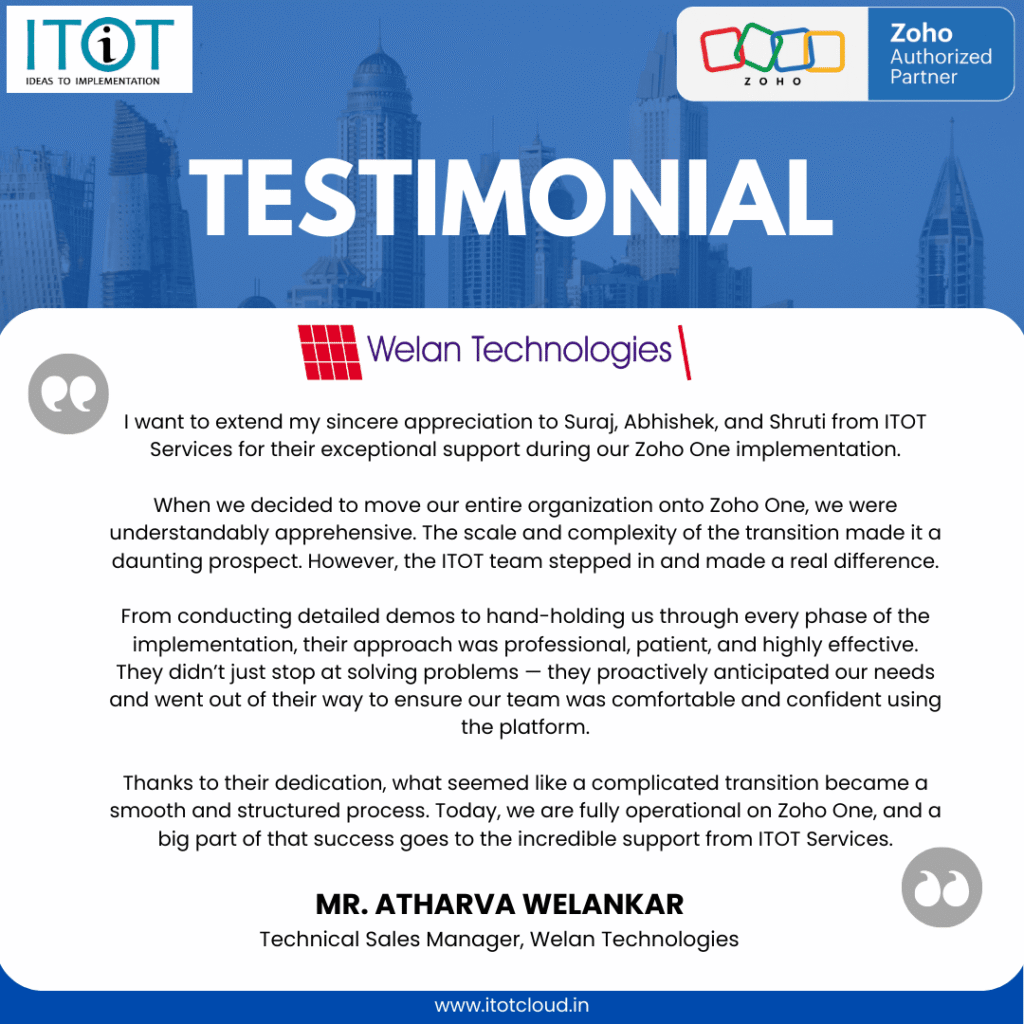
Client Testimonial: